IBM User Insights Hub
Making user research easier to discover, understand, and act on

Role
UX Designer
Timeline
6 weeks
Team
6 Designers, 2 Solution Architect, 2 Product Managers/Mentors
Platform
Web
Overview
The User Insights Hub (UIH) is IBM's internal research platform where teams can discover user research, understand customer needs, and reuse insights from previous studies.
Its audience spans the company, but the people who rely on it most are product managers, UX designers, and UX researchers, teams that make product decisions every day.
This project was part of IBM's Enterprise Design Thinking program, tackling a real product challenge with guidance from the UIH product team. The outcome was intended to inform future improvements to the platform.
Challenge
IBM had invested in a large repository of user research, but its value wasn't reaching the teams it was built for. The User Insights Hub needed to evolve from a document repository into a platform that helped teams quickly discover, understand, and apply research in their product decisions.
The problem wasn't a lack of research, it was making that research easy to discover and use.
We set out to redesign the experience so teams could move from searching for research to using research.
IBM Design Thinking Process
Since this project was part of IBM's Enterprise Design Thinking program, we followed a structured, collaborative design process while solving an authentic product problem.
The work evolved through continuous cycles of research, synthesis, ideation, prototyping and usability testing. We created empathy maps, updated personas, explored multiple concepts, prioritised ideas with stakeholders, and validated prototypes through several rounds of user feedback before refining the final experience.
Assumption & Questions

Understanding users through research
To understand where users struggled, we evaluated the existing product, interviewed users, and synthesized our findings using empathy maps, personas, user archetypes, and journey mapping.

User interview sessions
Our research included UX researchers, UX designers, and product managers. While each role had unique responsibilities, their workflows converged around a common pattern: they needed to quickly discover relevant research and turn it into actionable product decisions.
To guide the redesign, we centered our work around a Product Manager archetype, which represented the shared behaviors and needs observed across our primary user groups.
User archetype — Product Manager
Product Managers rely on customer research to shape product strategy, validate decisions, and align cross-functional teams. They value speed and clarity, preferring concise insights over lengthy reports. Their success depends on being able to quickly discover relevant research, understand its findings, and confidently apply those insights to ongoing product work.
Key insights from research
Our research revealed several recurring themes:
Many users didn't know the User Insights Hub existed.
Finding relevant studies was difficult because search and filtering weren't effective.
Users were overwhelmed by lengthy reports when they only needed the key findings.
Research was scattered across multiple files and external links, making exploration slow.
People wanted actionable insights they could consume in minutes, not hours.
The opportunity became clear: Help product manager discover relevant research faster and understand it with less effort.
Ideation
Prioritising ideas and features
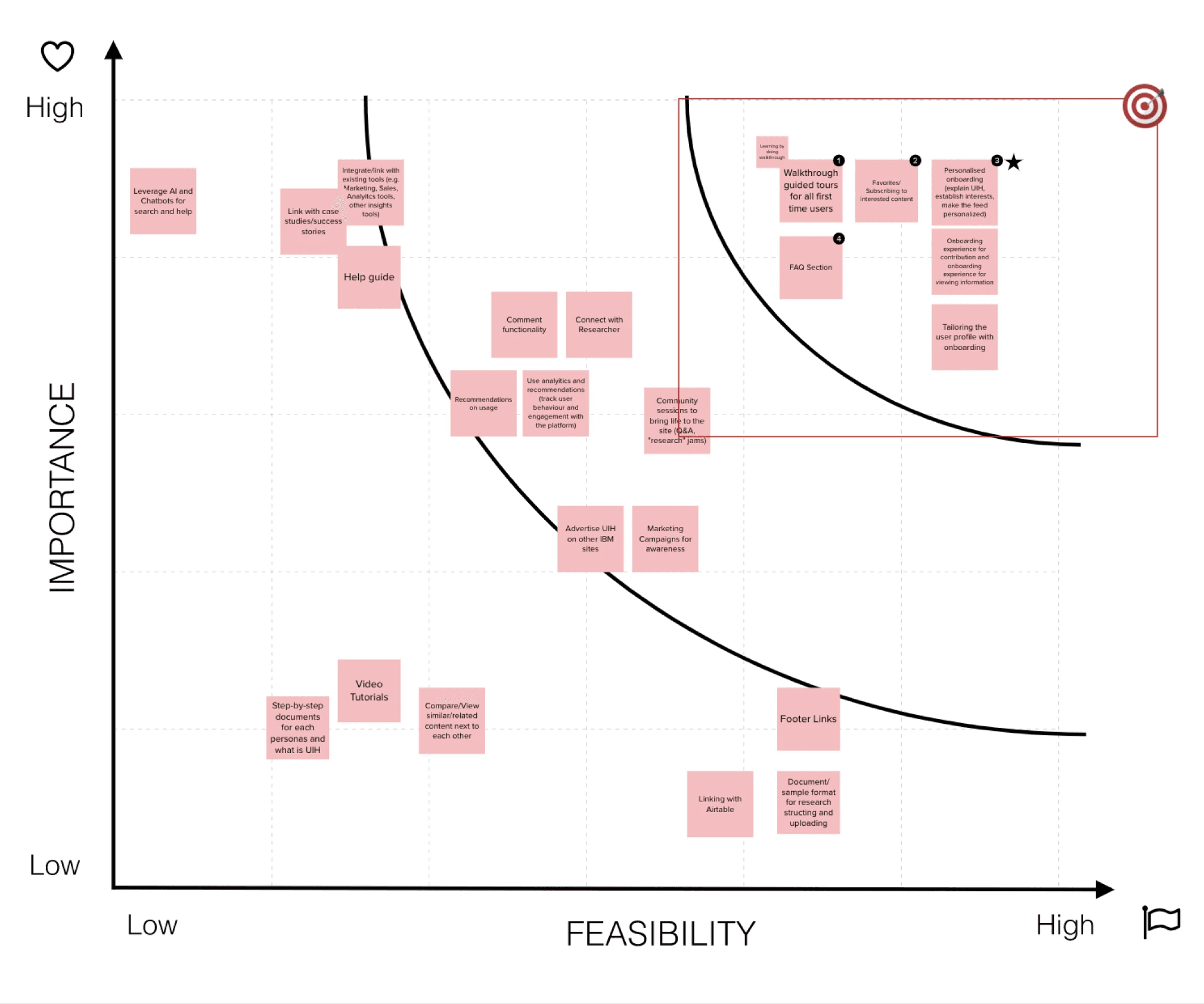
Shaping the experience
We translated our research into multiple interface concepts, rapidly sketching different navigation, onboarding, and discovery experiences before refining them into higher-fidelity designs.


Solution
Rather than redesigning every screen, we focused on the moments that created the most friction.
Personalized onboarding
A guided onboarding flow that captures user roles and interests to deliver a relevant experience from day one.
Design highlights
The redesign included:
Personalized onboarding for first-time users
Interactive product walkthrough
Simplified navigation and information architecture
Search-first landing page with advanced filtering
Personalized recommendations and bookmarks
Flexible research listing views
Rich research detail pages with summaries, recommendations, related studies, and downloadable resources
Outcome
By the end of six weeks, our team delivered a complete redesign covering onboarding, navigation, search, discovery and research consumption.

45%
faster research discovery
32%
drop in average time to find relevant insights
2x
increase in efficient, and data-driven decisions
"The new features are well justified by addressing key unmet needs and pain points, making the platform more relevant and ensuring users can quickly find what matters most to them."
Lesson
More importantly, the project reinforced an important lesson:
A successful research platform isn't measured by how much research it stores, but by how quickly people can turn that research into better product decisions.
Working on a real IBM product while applying Enterprise Design Thinking end-to-end gave me valuable experience balancing structured design methods with practical business needs, stakeholder collaboration and user-centred decision making.
